Monday, June 27, 2011
Adorable/Awkward/Hilarious/WTF?! child moment of the day
A ten year old boy came up to me today during a game of "Freeze Dance" (you just dance until the music stops and you have to freeze in your dance motion), and informed me that he "didn't know any dance moves." And asked if he could therefore "just move to the music." I was preparing myself for the "you can dance, it's ok if you look silly" pep talk, but he seemed totally fine with his idea of "just moving to the music," which, of course as I informed him, was in fact dancing.

Saturday, May 21, 2011
Farmer...Colyn?
Not really. I don't think I'm quite able to grow enough food to call myself a "farmer." But let's just say I would like to add it to the things I'd like to know how to do, you know, in case of a zombie apocalypse. Wait, is rapture today? Why did I even bother planting? Anyway, I have adopted a similar attitude toward the stuff that grows in the yard to that of my choice in clothing - I don't care so much how it looks, what does it DO? Plants are pretty good looking any way you slice it, so I'm not as much into their aesthetics as I am their function. I guess that's why I want to grow some food. Besides, who doesn't want a few more tomatoes available any time you want them for the whole summer?! A couple of weekends back, I got the soil prepared, adding top soil, peat moss, and slicing off a few more feet of grass to allow for more crops this year. I'm not quite at the composting point yet so I didn't have any home made dirt to add, but we might be able to make that work soon. I like the idea of a self-sustaining garden, but I'm not too sure how best to accomplish it at this point (and pops isn't too keen on the idea of letting stuff rot somewhere in his yard - on that note, I got a pretty swift "no" when I brought up the idea of chickens as well). The challenge here is always keeping the squirrels off of the tomatoes, which we were pretty successful with last year maybe by shear luck or perhaps they ate one of those cayenne peppers I was growing and thought better of testing the fruits. We also planted marigolds which I have heard keep squirrels away. I'm really looking forward to this year's garden, I think we could get a pretty good yield if I can keep up with the watering, trimming, weeding, etc. For those who care, we are growing three, maybe four different kinds of tomatoes, swiss chard, purple lettuce, squash, cauliflower, brussels sprouts, cayenne peppers, hot chiles, basil, parsley, rosemary, cilantro, and perhaps some garlic chives if I didn't kill them by now. Sounds like a tasty meal, eh? I'm looking forward to it all. Come over any time for a sample!


Tuesday, April 26, 2011
Adorable/Awkward/Hilarious/WTF?! child moment of the day
A second grade girl came up to me and said, "Mr. Flynn, I had a dream you were a ballerina," and walked away.
Wednesday, March 16, 2011
Just Like the Good Old Days?
I have been noticing a trend in the last few years that seems to be a multi-area movement to reexamine and reevaluate our perceptions on the “progress” made in several basic areas of human life specifically food and drink, reusables, and exercise. In each of these areas, I have observed a shift toward the styles of the past, and in some cases the distant past, in a very complete way. I do not discount the fact that I have been reading more and more lately, and that the media used to promote these ideas is almost exclusively print, or that these “trends” may simply be the effects of the liberal social realm in which I find myself. Either way, there is something going on and it seems to be catching on in more than just the liberal, leftist circles and I’d like to start looking at it from the perspective of beer.
I can’t say I’ve always liked beer, my first one that I can remember was a warm Busch Light at a party in high school which I couldn’t even force myself to choke down despite the social pressure, but now I like it a LOT. Even more, I prefer, most of the time, craft beer with unique, potent flavors, different textures, that challenges my brain to take a second look at what I’m drinking, but at the same time there’s always room for an ice cold American Lager when I’m in the mood. This preference was something I developed on my summer adventures in Seattle, where craft beer had already taken hold and people demanded tastier brews even in the divest of dive bars. I remember being disappointed when I would come home and try to find a solid pale ale or esb at the UIC college bars. However, in the years that followed, I began to see more and more craft brews spring up at bars that didn’t normally carry them (most of Chicago’s watering holes), and even more surprising, more and more craft breweries started opening up in the area. People I knew who I recalled having the “High Life Light is way better than Keystone Light” conversation with, suddenly were asking if I’d ever had the 3 Floyd’s Alpha King, and celebrations of Dark Lord Day began to include a wider population than the bearded, tatted, pierced beer geek gang. When I ask people (from behind the counter of the finest wine and spirits store in the galaxy) what the beer that did it for them was, what made them trade taste for quantity, what made them pay a little more per bottle they usually have a memory of a friend sharing something delicious or going to a brewery somewhere, but included in almost all their answers is that they feel like they are drinking real beer. Real beer? After the flashbacks of the scene in Hook where the lost boys feast on nothing subside, I think that maybe there’s something to this. Reality, in this case, is how well they are perceiving it. How much do I know about this beer? Where did it come from? What was it made with? Why was it made to taste/look/feel this way? Who made it? The more we know about this thing we are putting in our bodies, the more we believe in it and the more real it becomes to us. Surely this influences taste, but I think it tickles another fancy that more and more people are developing: a preference toward responsible and anthropological motives for what they do. This principle is directly opposing the commercial, big business, tell-you-what-you-want kind of philosophy that has dominated food production and distribution (and still does in most ways). I would like to think that this is due to a shift away from commercialism and consumerism, but I highly doubt that that is truly the case, instead it might be a more sustainable, responsible version of the same (the lessor of two evils).
I am including food (and wine) production as analogous to beer. I cannot speak for the rest of the nation, but in Chicago anyway, there are more and more community supported agriculture (CSA) options than ever before. I hear my friends and acquaintances talking about their Saturday rituals of heading to the farmers’ market(s) around town, of which there are more and more. I recently watched a documentary called The Truth About Farmer John which chronicled an Illinois farmer’s struggles with his personal demons and those that accompany any midwestern monoculturalist. His final solution to the problem of what to do with his farm and how not to lose it was to make it a CSA, a rather novel idea when you look at it through the eyes of a businessman. How do you say, “hey everybody, I have a farm that is totally organic, but small. The harvest is susceptible to all kinds of problems that could be solved with pesticides and chemicals but I’m not going to use those and therefore can’t guarantee you’ll get produce from me, but please give me a bunch of money in the spring and we’ll see what happens,” and think you’re going to make it in a world built around big-business, large-scale farming that produces all our foods from one or two raw ingredients and makes it taste extra good through all the things added to it? The only explanation I can think of is that people are starting to realize that, though it was the past, there were some things about agriculture we had right before the huge monoculture farms took over and the scientists made our food with chemicals. There is a way to be profitable and sustainable, you just have to have some faith and everyone has to work for it together.
Another idea that I have been exposed to recently through my friends who practice Crossfit is the Paleolithic diet. This diet is based simply on what our ancestors ate, the driving idea being that we evolved to eat this way and the agricultural revolution is too recent for our bodies to adapt, if we are going to at all. I have to say, it sounds like one of the most logical and complete diets I have come across to date. It doesn’t make any of the mistakes of the failed fad diets which demonize or omit a certain nutrient (think “carbs are evil” “fat is evil”), rather it embraces them all, they just say that there is a proper delivery method and proportion for each nutrient that can be approximated by how our distant ancestors ate. I’ll let you google it for the specifics, but I found it interesting that someone thought, “Hey, why don’t we look at diet from an anthropological perspective and see what we are made to eat rather than just keep breaking down chemicals to their lowest common denominator and build food without the natural complexity of its delivery system.” This diet assumes we do not know everything there is to know about how food interacts in our body, but we can try banking on two million years of evolution and see how that works.
Feel free to stop reading if you think I’m blatantly plagiarizing The Omnivore's Dilema and In Defense of Food, but I think the ideas go a little beyond what we put in our body. For instance, the idea of bringing your own bags to the grocery store, containers to restaurants, your own coffee mug to Starbucks! These are things that I was amazed I had never considered before they became popular. I mean, they benefit both parties and they prevent waste, duh! However, culturally, they were totally foreign and strange. I mean, if one had no concept of the supermarket and you told me about it, one might think that they would need some way of carrying the goods back home and one would not be crazy to think “Oh, I better grab a bag or a cart in which to bring the stuff home.” Something like this requires very little effort other than getting over the tradition of not doing it, which I have to say, I fail at over and over.
The next glaring example of the idea that maybe we don’t need all this extra stuff and we had it right before in many ways is the notion that our bodies are, for the most part, made correctly. Everyone can see the glaring examples of how people believe that the only way to achieve perfection of their body is to do something to it: wear something, put on makeup, shave, trim, clip, take supplements, eat special foods, etc. There is very little out there telling us, you are fine the way you are, just don’t lose it! That is an idea that I think goes along with this whole food, wine, beer, reusables, etc., in that it shows that people long ago (in this case pre-historic long ago) had some things right. More and more evidence, or at least idealists are coming out and saying “More equipment is not the answer. More complex supplements are not the answer. The answer is less external, more internal.” I watched a lecture by Christopher McDougall, the author of Born to Run (which I plan to read as soon as I finish my second round of The Fountainhead) in which he said plainly, (I’m paraphrasing here) “Humans are made to run very long distances, in our bare feet. We are not built for speed, we run long, relying on the large amount of springy connective tissue in our legs and we don’t need any special gear to do so.” He also contends that running barefoot will benefit posture, arches if you have flat feet, callused tissue on the foot, pretty much anything wrong with you mechanically. I can not testify to the effectiveness of running barefoot, but I can say that the thought of defending barefoot running against the standard form of shoes with thick padding and arch support seems backwards to me in the first place. Barefoot was first, should we not be defending shoes against that? I should add, to clarify, that McDougall does not necessarily mean literally barefoot, he runs in Vibram Five Fingers and is simply saying that we should run in something that is going to protect us from getting glass in your foot, but not something that is going to support us in some way we were not built to be supported.
I have to say, I really like this idea, it feels like the craft beer of exercising; it’s been around forever, but it had been almost forgotten in mainstream culture. It has always been the real way of doing things, but we thought we could dominate nature, perhaps we need to stop trying to dominate nature and rather learn to work with it better. Perhaps we have more to learn from our past and our ancestors than we have cared to think. Perhaps some of our “primitive” ways we not so primitive at all. Perhaps we oversimplified and in doing so lost something that nature’s complexity brings to us. Perhaps we lost what we had as children, that drive that lets us enjoy running for the sake of running, that which keeps the grin on our face after hours outside playing in the park and which might keep it there after mile fifty with fifty more to go. Whatever we did, I feel like there is some truth in the idea that we might have been missing something in how we have been doing things lately and that we may just be as smart as we think we are, just not in the way we have been thinking.
Friday, January 28, 2011
The Sun! It's so simple...
I can't say that I've ever noticed how the short days of the winter months affect my mood as much as this year. At least three days a week I take the train(s) to work, which means that I leave the house at 6:30 am and get home close to 6:00 pm. In the winter, this means I leave when it's dark and I get home when it's dark. The shortest days of the year this winter seemed to last forever, and this week was especially dragging, what with the four or five days of consistent gray overcast that blocked out the sun and the fact that I spend most of my days at work in windowless rooms. I will admit, I hadn't felt like I really got over that virus I had after the new year fully until I walked out of the house this morning and saw that the sky was not it's usual, Chicago street light orange color, but the light blue of the first light of dawn. Very poetic, sorry for the nausea I just caused you... Anyway, I feel like a million bucks and I can't help but thinking that it's that morning sun. It could be that it's Friday and we have Buick practice tomorrow, and the kids have been pretty well behaved this week, etc. as well, but that sun this morning really energized me. Enough to post about it anyway!
Sunday, January 9, 2011
R-E-A-D-A-B-O-O-K
I'd like to make it clear that I have no intention of critiquing any works of literature on this blog, as I am woefully unqualified to do so, but I figured I'd write about a book I just read. It's a rather rare occurrence that I finish a book so I suppose it's worth marking the occasion with a few words.
I've been lucky enough to stumble upon a couple of really good reads in a bookstore in Oak Park called The Book Table while buying Ayn Rand books as gifts for people (and myself). Anyway, the first of the pair I stumbled upon was Miracle In The Andes by Nando Parrado who was one of the survivors of the plane crash in the 1970s that left a group of Uruguayan rugby players marooned high in the Andes for 72 days. The story is incredible to say the least. It was made into a movie starring Ethan Hawke that was based on the book Alive. I have not read that particular version of the story, and I'm sure that there are some discrepancies between that account and the one I read by Parrado. Either way, it is an extremely personal, moving, and intense account of what happens at the extremes of human experience. It certainly filled the void in my need for adventure left by finishing Chasing Che, another incredible book that has inspired in me an interest in Latin America, both geographically and socially. I digress. I recall feeling the full range of human emotion reading Miracle in the Andes, something I can't say I expected from any story. Reading a story like this makes me think if I have what it takes to survive something like these men did and make it clear that I hope to never have to find out.
After plowing through Miracle in the Andes, I went back to the Book Table one day mainly out of boredom, and to replace my copy of The Fountainhead, which I gave away. I walked around and felt lost. I felt like what I expect a lot of people feel coming into a wine store for the first time: completely lost. I didn't know what I wanted to read, I wasn't sure which section to look in. I didn't want to just pick a pretty cover. So I wandered around aimlessly looking for something to strike my eye. After grazing around the fiction section, I came across Cormac McCarthy's area in the fiction section. I'm not sure where I heard his name before, other than my cousin Jonny's middle name, but I picked up The Road and read the teaser on the back. It sounded good, adventure, danger, very personal, fiction.
The book is written in a very strange perspective, sort of a little third/first/first or something. Hard to explain, but it took a little getting used to. It's a post apocalyptic world where a father and son are traveling, more or less aimlessly, and just trying to survive. They scavenge and run, fight and evade. It reminded me of a zombie story except no real zombies, just cannibals. It was a fast read once I got used to McCarthy's writing style, but what really struck me was that, in spite of the very stripped down language (lots of abstract description and dialogue without explicit cues to who is speaking - "he said") I felt like I got to know the characters very well by the end of the book based only on their actions and words. I think it actually felt more real that way, like I was experiencing them for myself. I think that, if someone else were to read this book they might have a very different opinion of who the characters are.
Well, there you have it, some books I've read recently, yay I read stuff!
Thursday, December 30, 2010
OXYGEN!!!
Sometimes when I'm feeling pensive or in need of a little oxygen, I take the green line out to the Garfield Park Conservatory. This is one of my favorite places in Chicago, especially in the winter time. It's a huge, old greenhouse with room after room of incredible plants.
I was hoping to skip town for the new year, but it didn't work out and I was feeling the need for a little warmth and fresh air. Ironically, one of the only places to find fresh air in Chicago in the winter is indoors, here at the conservatory. They usually close at 5pm, but on Wednesdays they stay open until 8pm. It happened to be Wednesday yesterday and I decided to go and read amongst the plants. When I arrived, I was surprised to find that, though the conservatory was open, most of the lights had been turned off (or perhaps not turned on, as it is a big, glass building with plenty of natural light during the day). Reading in this situation proved a bit difficult, so I just walked around and enjoyed the smells and extra oxygen. Here are some pictures I managed to take with my camera propped against something to keep it steady. If you ever find yourself looking for a place to escape to in the city, I highly recommend going here, and calling me up.
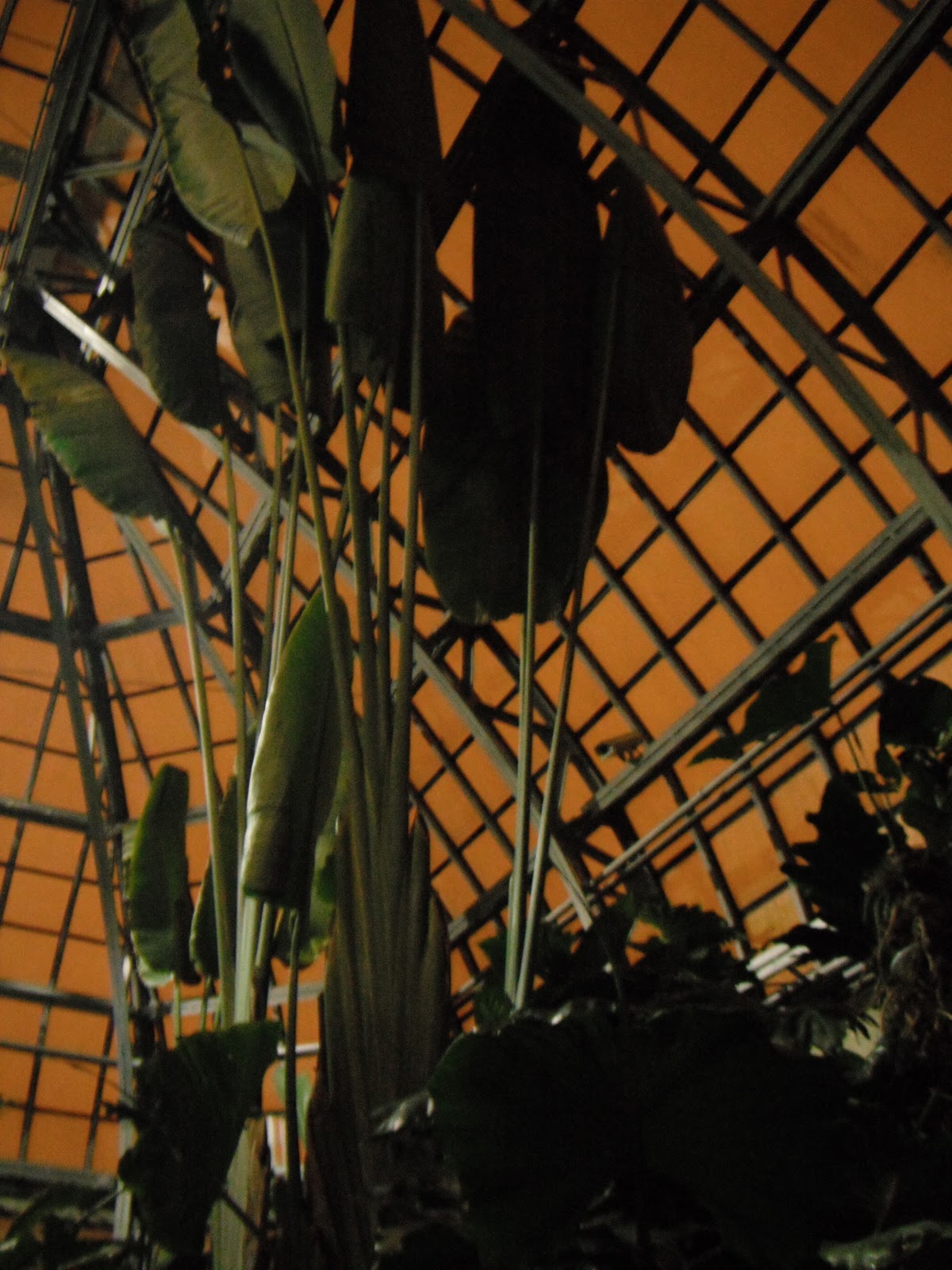
Some HUGE palms in the main (palm) room.

They're Agave plant is flowering! This, apparently, is a rare event and the whole ordeal lasts up to a year or so. The flowers bloom on the tips of a stalk that shoots up from the middle of the leaves and grows up to thirty feet tall. The stalk, though I couldn't see it well in the dim light, is said to be reminiscent of asparagus (as the agave is related to asparagus).

Cool, green lights on the desert at night.


Chihuly, the famous blown glass artist, had an exhibit here a few years back in which he displayed his artwork along with the plants. I remember thinking it was very impressive, and I was surprised at how well Chihuly was able to integrate his man-made works into the natural beauty supplied by the plants. These are a few of the pieces he left for permanent display at the conservatory.
Subscribe to:
Posts (Atom)


